πŸ“„ Read Paper

Open Source Research

ARIA

Adaptive Robotic Intelligence for Aging

An open-source initiative creating accessible AI-powered companion systems for individuals with Parkinson's disease. Research-backed. Buildable for under $500. Because dignity shouldn't have a price barrier.

10M
People living with Parkinson's worldwide
60%
Experience freezing of gait (FoG)
68%
FoG reduction with rhythmic cueing
<$500
Cost to build any ARIA variant

The ARIA Product Family

Six form factors designed for different needsβ€”all sharing a common AI backbone and open-source design.

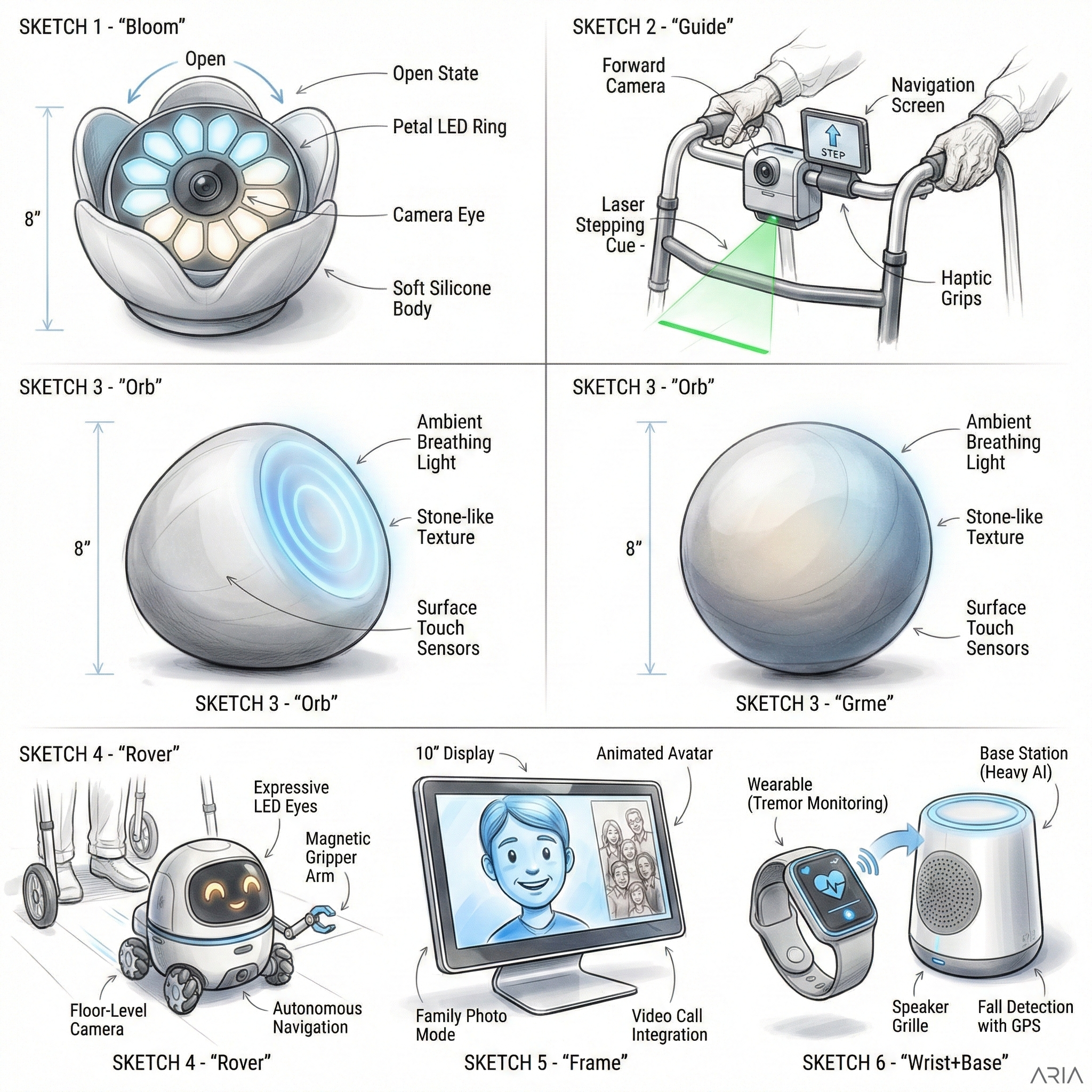
ARIA Product Family - Six design concepts including Bloom, Guide, Orb, Rover, Frame, and Wrist+Base

Figure 1: ARIA product family concept designs. From left: Bloom (tabletop companion), Guide (walker-integrated), Orb (ambient presence), Rover (mobile companion), Frame (digital portrait), Wrist+Base (wearable hybrid).

The Science Behind ARIA

Understanding why external cueing works requires understanding what breaks in Parkinson's disease.

How Gait Normally Works

Walking is mostly automaticβ€”your brain's basal ganglia (deep brain structures) generate internal timing signals that sequence your steps without conscious thought. You don't think "lift right foot, swing forward, plant heel, shift weight..."β€”it just happens.

Normal Walking Neural Loop
Basal Ganglia β†’ Internal Rhythm β†’ Motor Cortex β†’ Leg Movement
       ↑                                                    ↓
       └──────────────── Feedback Loop β”€β”€β”€β”€β”€β”€β”€β”€β”€β”€β”€β”€β”€β”€β”€β”€β”€β”€β”€β”€β”˜

The basal ganglia act as an internal metronome, providing the rhythmic timing that allows walking to feel effortless and automatic.

What Breaks in Parkinson's Disease

Parkinson's disease damages dopamine-producing neurons in the substantia nigra, which connects to the basal ganglia. Without adequate dopamine, the internal rhythm generator fails. The brain literally loses its internal metronome.

Parkinson's Walking (Broken Pathway)
Basal Ganglia β†’ ❌ NO SIGNAL β†’ Motor Cortex β†’ Nothing happens
       ↑
       └── Dopamine depleted, rhythm generator offline
Freezing of Gait (FoG)

Freezing of Gait occurs when the person wants to walkβ€”the motor cortex is readyβ€”but the internal timing signal never arrives. Feet feel "glued to the floor." Episodes are often triggered at doorways, turns, or when initiating walking. It's not weakness or fearβ€”it's a neurological signal failure.

Why External Cueing Works: The Neural Bypass

Here's the critical insight: the motor cortex still works perfectly. Only the internal timing mechanism is broken. External cues provide a substitute rhythm that bypasses the damaged basal ganglia entirely, using sensory pathways that remain intact.

External Cueing Bypass Mechanism
                          β”Œβ”€β”€β”€β”€β”€β”€β”€ BYPASS ───────┐
                          ↓                      β”‚
Eyes/Ears β†’ Sensory Cortex β†’ Motor Cortex β†’ Walking!
     β”‚
Laser line / Metronome click

Visual Cueing (Laser Line)

Projects a target 18 inches ahead of feet. The brain treats it as an obstacle to step over, recruiting visual-motor pathways instead of basal ganglia. Each new line position triggers a conscious step, converting automatic walking into a series of visual targets.

Auditory Cueing (Metronome)

Provides external rhythm at ~100 BPM. The auditory cortex receives the beat and directly activates motor timing circuits. Patients synchronize steps to clicksβ€”the beat becomes the missing internal metronome. Works even with eyes closed.

Why the Effect Is Immediate

This isn't therapy that takes weeks of training. The effect is instant because:

  1. The motor system is fully intactβ€”it's just waiting for a "go" signal
  2. External cues provide that signal through an alternate neural route
  3. The moment the cue appears, the brain has something to respond to
Clinical Evidence

Harvard SEAS studies demonstrated a 68% reduction in freezing episodes with rhythmic cueing. Their soft robotic exosuit with rhythmic assistance improved walking distance by 55% and completely abolished freezing of gait during interior walking. Visual laser cueing showed immediate effect in 94% of participants.

ARIA Guide Implementation

ARIA Guide translates this neuroscience into a practical intervention system:

ARIA Guide Intervention Sequence
Detection:   Camera sees feet stopped > 2 seconds
     ↓
Visual Cue:  Projects green laser line 18" ahead (stepping target)
     ↓
Audio Cue:   Starts metronome at 100 BPM (rhythm substitute)
     ↓
Patient:    Steps onto line, synchronized to beat
     ↓
System:     Advances laser, maintains rhythm until walking fluid
     ↓
Result:     Walking restored in seconds

The laser and metronome aren't "helping" the damaged systemβ€”they're replacing the broken internal signal with an external one that uses pathways that still work perfectly.

ARIA in Action

See how ARIA's neural bypass intervention system works in real-world scenarios. These concept visualizations demonstrate the core interaction patterns.

ARIA Guide: Freezing of Gait Intervention

Walker-integrated system detects freezing episode and deploys laser line cueing with rhythmic audio to restore gait initiation.

ARIA Bloom: Medication Reminder & Companionship

Tabletop companion provides gentle medication reminders, tracks speech patterns, and maintains connection to family through conversational AI.

Concept visualizations generated with Google Veo 3

Product Specifications

Each ARIA variant addresses specific needs. All share the same AI backbone and can be built with common tools and components.

ARIA Frame

~$220

Digital portrait companion in picture frame form factor. Shows family photos when idle, animated avatar during conversation. Lowest build complexity.

  • 10" display with avatar
  • Family photo slideshow
  • Video calling integration
  • Cognitive games & exercises
  • Wall-mount or tabletop

ARIA Rover

~$430

Mobile companion robot that follows users room-to-room. Provides active companionship and can fetch small objects with magnetic gripper.

  • Autonomous home navigation
  • Room-to-room following
  • Magnetic gripper for fetching
  • Floor-level fall detection
  • Expressive LED eyes

Research References

ARIA is built on peer-reviewed research in neuroscience, assistive robotics, and Parkinson's care.

  1. Soft Robotics for Parkinson's Disease Supported by Functional Materials and Artificial Intelligence.
    PMC/BME Frontiers, 2025.
    pmc.ncbi.nlm.nih.gov/articles/PMC12214301
  2. Soft Robotic Wearable Device Improves Walking for Individual with Parkinson's Disease.
    Harvard SEAS, January 2024.
    seas.harvard.edu/news/2024/01/soft-robotic-wearable
  3. Socially Assistive Robots for Parkinson's Disease: Needs, Attitudes and Specific Applications as Identified by Healthcare Professionals.
    ACM Transactions on Human-Robot Interaction, 2023.
    dl.acm.org/doi/10.1145/3570168
  4. Recommendations for Designing Conversational Companion Robots with Older Adults through Foundation Models.
    Frontiers in Robotics and AI / PMC, 2024.
    pmc.ncbi.nlm.nih.gov/articles/PMC11163135
  5. A Novel Socially Assistive Robotic Platform for Cognitive-Motor Exercises for Individuals with Parkinson's Disease.
    Frontiers in Robotics and AI, 2023.
    frontiersin.org/articles/10.3389/frobt.2023.1267458
  6. Challenges in Designing a Fully Autonomous Socially Assistive Robot for People with Parkinson's Disease.
    Tufts HRI Lab, 2020.
    hrilab.tufts.edu/publications/wilsonetal20pd
  7. An Interdisciplinary Approach to Assistive Technology for Parkinson's Disease Dementia.
    PMC, 2025.
    pmc.ncbi.nlm.nih.gov/articles/PMC12363541
  8. How AI is Revolutionizing Parkinson's Research & Care.
    American Parkinson Disease Association.
    apdaparkinson.org/article/ai-and-parkinsons

Build Your Own

Complete documentation to build any ARIA variant. No prior robotics experience required.

1

Hardware Assembly

Step-by-step guide with video. 3D print files included. 4-6 hours build time.

2

Software Setup

One-click Raspberry Pi image. Flash, boot, configure. All AI models pre-loaded.

3

Personalization

Train ARIA to recognize voices. Set medication schedules. Add family contacts.

4

Community Support

Active Discord. Weekly build sessions. Troubleshooting from builders worldwide.

πŸ“„ Read the Research